
Postscript
Thoughts following the longest thing I've ever written

“When we say domestic workers, we’re only, you know, cleaning houses and doing housework. We have potential to be a leader. We have potential to be authors if we wanted to one day, so it’s (about) developing our talents.”
This was a quote from Ellen Lavilla, whom I interviewed for the story I wrote, Flipping The Script: Migrant Writers of Singapore. The title is a play on words, as Ellen had written the script for "The Homecoming", a play that displayed how complex community building can be for transient migrant workers pulled by the longing--and responsibility--to return home. Ellen is a writer and is herself a core member of the group. She has worked in Singapore for over two decades.
I was first drawn to MWS because I was keen to explore how a group of migrant workers who spent their day off in writing workshops was building a unique kind of community. In a post I wrote a year ago, I was curious about how migrant worker communities are typically covered in the media, and how some have turned to art to express and represent themselves authentically. What followed was a months-long process of scheduling, conducting, and transcribing interviews with key members of the group, as well as recording conversations and downloading chat threads with other individual supporters of MWS’ work (a big shout-out to Sing Lit Station) to better understand this niche community of artists.
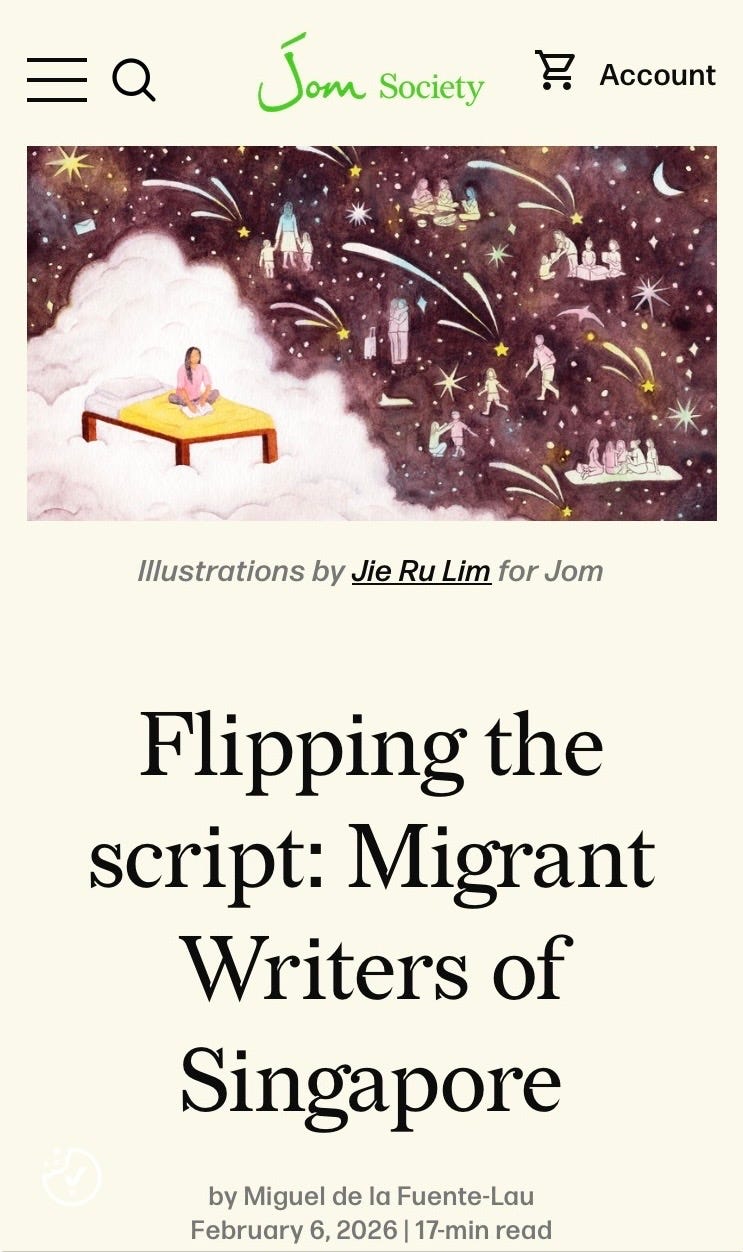
I was very lucky to have had the wonderful team at Jom support the story from the jump, and what I share here is a collection of snippets from the final published piece. (Please consider subscribing! Then you can read the full 4,000 words; Artwork credit: Jie Ru Lim)
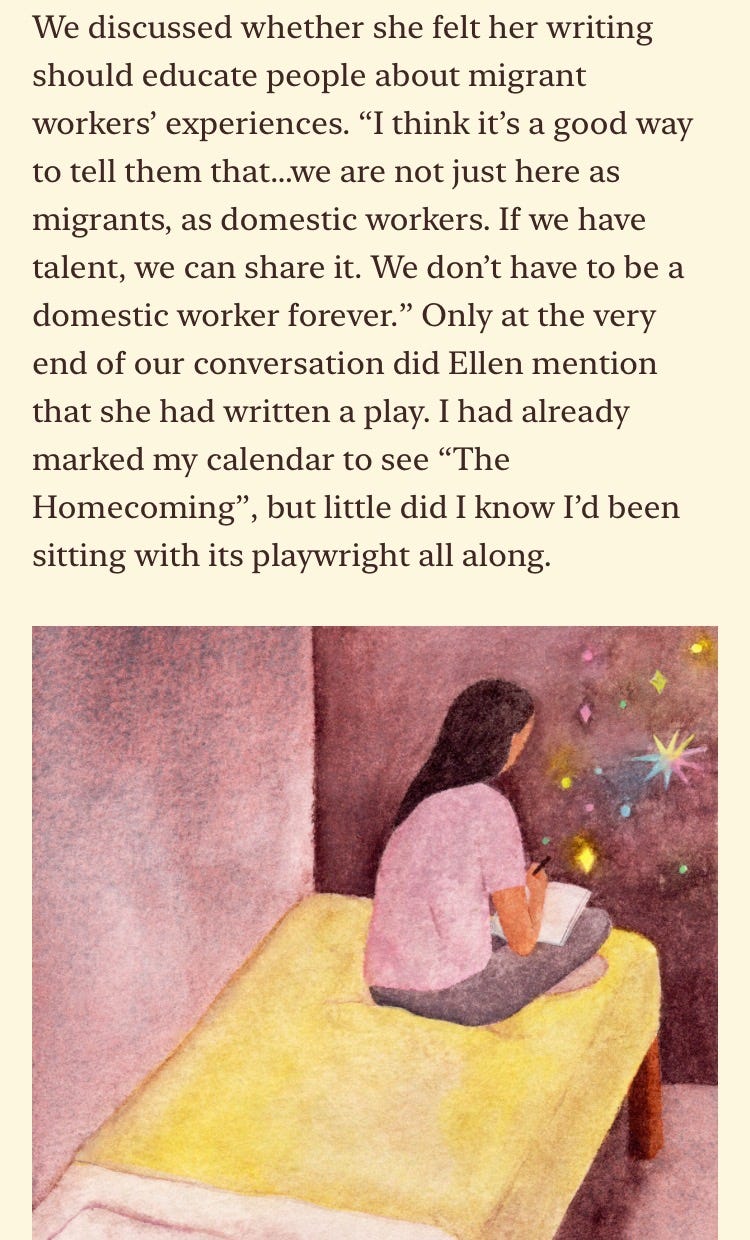
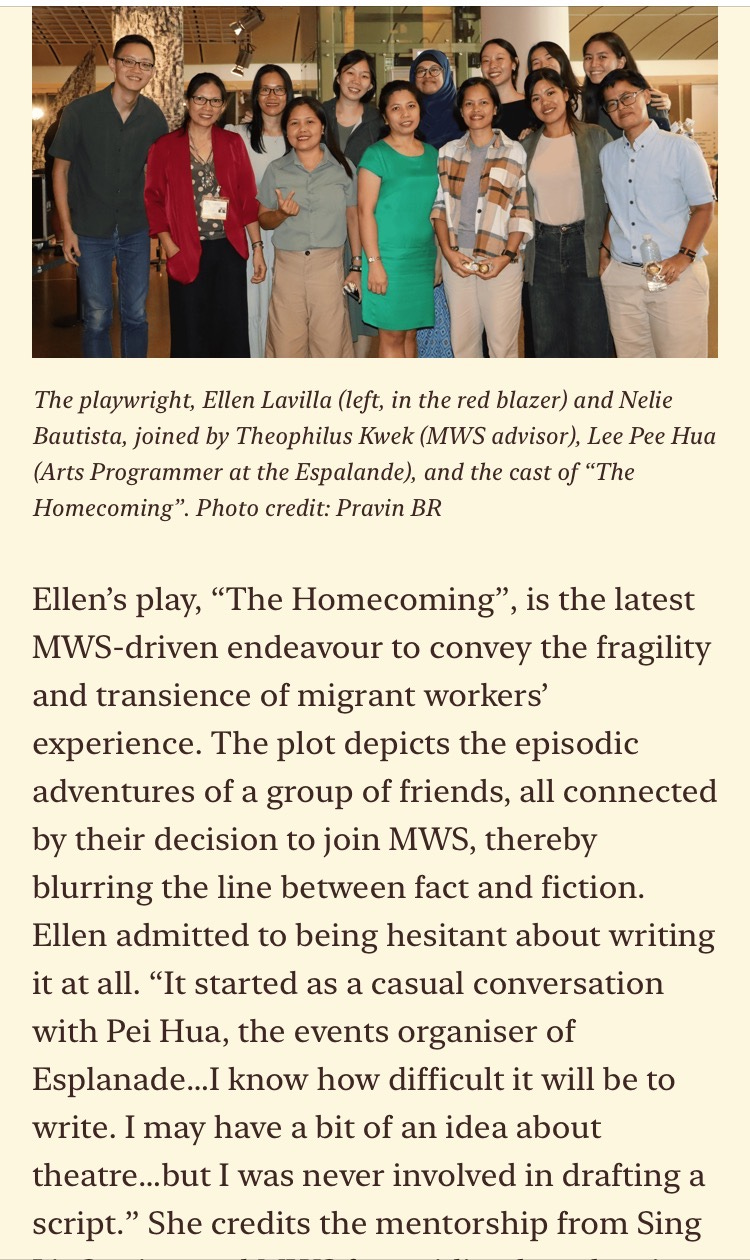
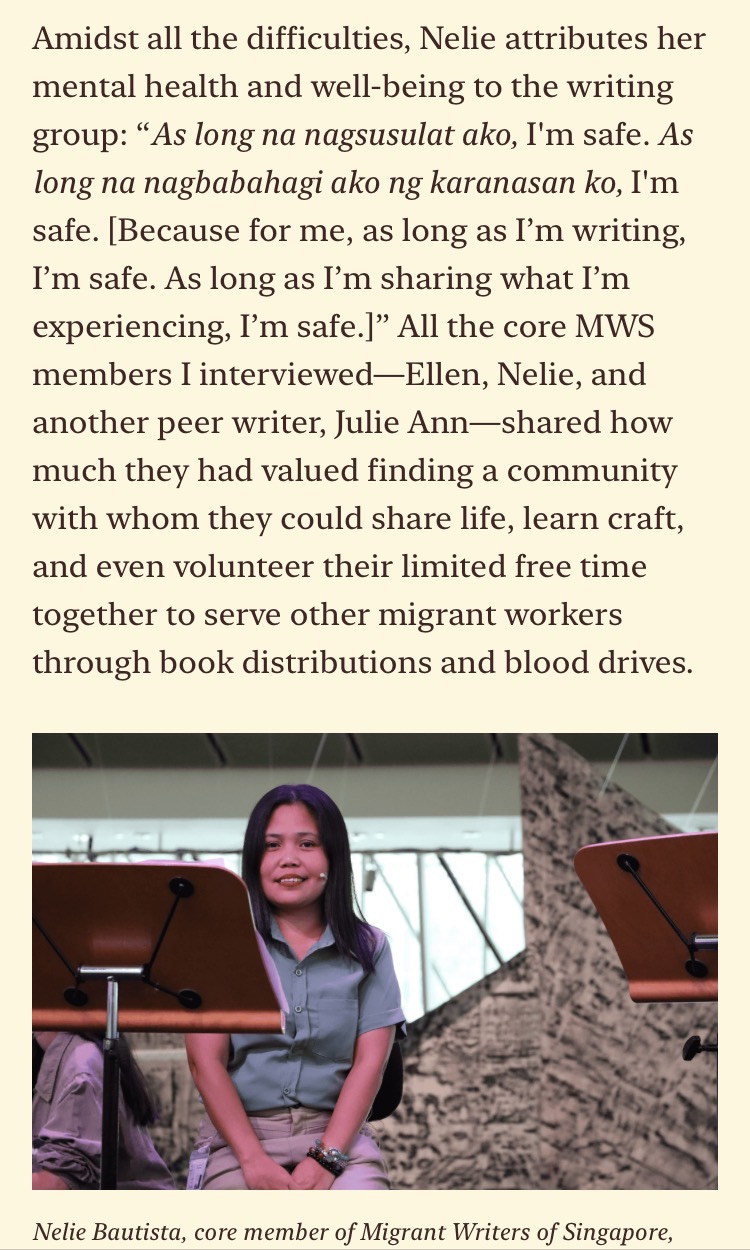
I share the excerpts above that include photos of Ellen, Nelie, and their peers, because they are the true beating heart of the story. At its core, I had always wanted the piece to be a human-interest story first, not an educational one. But if you read Jom’s own posts on social media that pushed the piece (like this one on LinkedIn and on Instagram), you get a sense of the opportunity the publication had to situate the story within the context of a much larger development of migrant writing as a movement locally and beyond the region. As such, if you were to only read the bits and pieces of the essay as circulated on social media, one might get the sense that this was a much more academic pursuit.
I cannot overstate how grateful I am to the editors at Jom for pushing me toward writing something far larger in scope than I had intended. They nudged me gently, over and over, and we arrived at a piece that, I hope, struck somewhat of a balance between historically informative and personally relatable and relevant. But as much as I personally benefited from the patient and meticulous editorial support I received from the Jom team to produce this story, truth be told, our finished work together looked markedly different from the initial story I had in mind. I wouldn’t be honest if I said that that was the piece I aimed to write all along.
And that’s ok!
As a writer, I felt incredibly stretched—and exhausted—by the process. This was good for me. I needed this challenge. But as someone who took the time to get to know the women in this group, who, in turn, received their immediate trust to tell parts of their stories, I couldn’t help but feel that what I had written in the end didn’t read and sound like something with them necessarily in mind as an audience.
It was a lesson learned in how, when we put something out into the world and find the courage to give our vision for it the slightest chance to breathe, we also lose control over how that vision is received. It moves beyond how we had first molded it in our minds, only to be captured, shaped, and shared as a new creation by others.
And that is also ok.
It’s ok because I trust the process we had: writing collaboratively, with respect for the truth, and with deep sensitivity to the vulnerability of the stories we held.
Some parts of the story will resonate most strongly with Jom’s most avid readers. Perhaps after reading the story, expatriated Singaporeans thousands of miles from here might have been compelled to revisit their country’s policies protecting—or not—its workers who live in the shadows. Perhaps after reading the story, a domestic worker in MWS who happened to get a full copy of the story found in it even the slightest encouragement to give it a shot at writing an essay of their own.
I will never know.
But I learned to let my expectations go. Honestly, I’m just relieved that it’s finished.
And besides, the story isn’t even about me or what I wanted out of it. That’s part of the point. It isn’t about any of us who prognosticate time and again about whether or not this transient community of writers and artists within Singapore will ever become, dare I say, ‘mainstream’. The questions I pose in the quote below are the questions that those of us on the outside looking in are far more interested in.
Can performance-driven avenues such as poetry competitions and state-supported writing festivals complicate prevailing narratives about migrant life in Singaporean society? Can these spaces adequately dispel highly subjective notions of what “good writing” is—problematising the ambiguous criteria against which it is measured, and questioning who has the authority to apply it? In addition, the ongoing conversation about “migrant” versus “local” writing remains a salient topic for the literary community, but perhaps it is best reserved for a public forum, where the ideas that confront the question about why such distinctions matter can be debated publicly. Meanwhile, taking place in an entirely different space out of public view, the grind of growing one’s craft tethers together the Migrant Writers of Singapore, week after week.
I’m going to go ahead and give away the ending:
After watching Ellen perform and recalling my conversations with her, it is clear she has a hunger to improve as a writer and genuinely approaches her work as a craft. This helps explain in part why she never misses Sundays. Just like any writer serious about cultivating their talent, she models what it means to “show up” to the work regularly, push forward new ideas, and diligently workshop them with peers.
One day, might the writers at MWS remember themselves not only as migrant workers in Singapore, but also as artists whose unique stories have shaped the cultural tapestry of this cosmopolitan city? Could they see their contributions as a call for a more cohesive and inclusive society? Maybe. As things stand today, their ambitions appear more modest. Every Sunday, they show up in a quiet room along Dickson Road. And amid the laughter, tears, and energy of creating together, they hone their craft without any pretense, receive each other’s work without judgment, and make room for their whole selves to emerge, buoyed by community.
It was never about how we saw them.
It was really about how they saw themselves.
And in the end, after all the events I attended, the conversations I recorded, the interviews I transcribed and translated, I have little doubt that something profound had already shifted long before I came around to ever writing this.
These writers already carry with them a deep and precious truth. Just go back to the beginning and read it for yourself.